Over the past few decades, biopharmaceuticals (or biologics) have transformed the modern treatment of complex human diseases. Unlike small molecule drugs, these high-value therapeutics are produced by living cells that are isolated from the host of origin and engineered to express genes that produce the protein of interest. Mammalian cell lines, especially Chinese hamster ovary (CHO) cells, have been predominantly used in cell culture because of their ability to achieve high cell density and appropriate post-translation modifications for therapeutic needs. Significant strides have been made to develop cell lines and bioprocesses that achieve high production rates and stable product quality for mass production. However, the development of a cell culture process for a new product remains very time-consuming and costly. In our work, which crucially relies on close collaboration with experimentalists, we develop computational tools that can help accelerate development timelines and improve process performance.
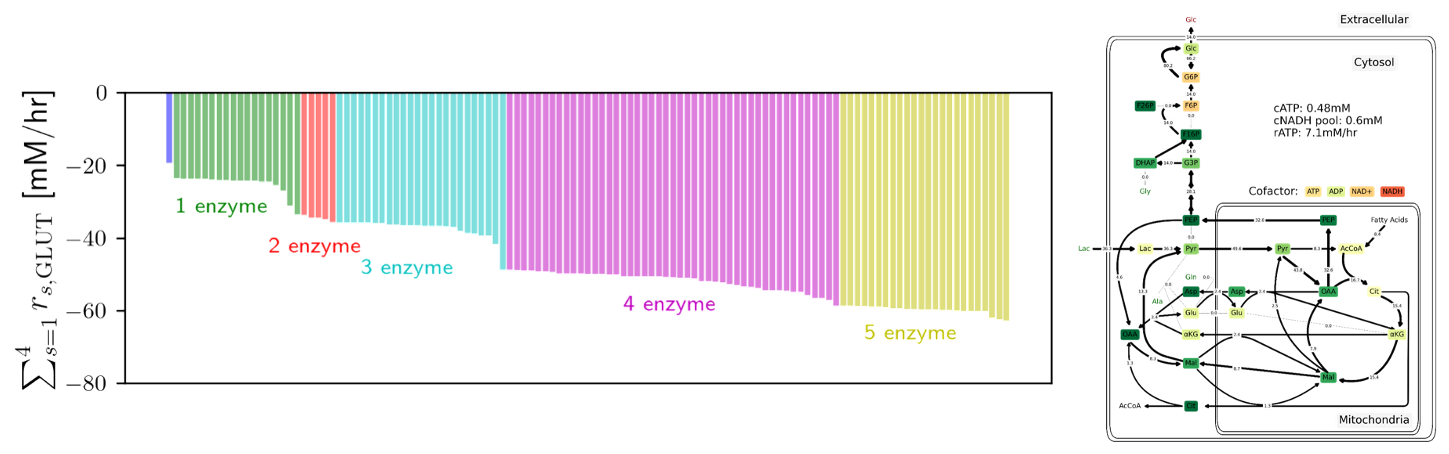
A major challenge in bioprocess modeling is the availability of data. While large volumes of data can be collected from an established manufacturing process, only very limited amounts of data are available from the cell line and process development phases. Yet it is in these early development phases where our choices of cell line, media, and process conditions can have a major impact on the ultimate bioprocess; hence, being able to predict the process behavior at the manufacturing scale early on could significantly improve and accelerate the development process. To achieve this, we develop multiscale hybrid bioprocess models that combine mechanistic and data-driven metabolic modeling as well as bioreactor modeling that accounts for cell growth, signaling regulation, and reactor environment. We also apply transfer learning to leverage data across multiple cell lines. Once a predictive model is established, we can use it to optimize the corresponding bioprocess. For example, in the figure below, we demonstrate how we can modify metabolic pathways by adjusting the expression levels of certain enzymes to maximize the production of a desired metabolite.
Selected Publications
- Srinivasan, P., Kuo, H.-J., Lin, Y.-C., Lu, Y.-A., Hu, W.-S., & Zhang, Q. (2026). A mechanistic model of rAAV production in synthetic cell lines. Biotechnology & Bioengineering, 123(6), 1684-1694.
- Kuo, H.-J., Srinivasan, P., Lin, Y.-C., Lu, M., Rungkittikhun, C., Zhang, Q., & Hu, W.-S. (2025). Transcriptomic functional characterization of recombinant adeno-associated virus producing cell line adapted to suspension-growth. Biotechnology Process, 41(5), e70042.
- Lu, Y.-A., Fukae, Y., Hu, W.-S., & Zhang, Q. (2025). Recurrent neural networks for forecasting time-varying process behavior in mammalian cell culture. Industrial & Engineering Chemistry Research, 64(18), 9048–9058.
- Lu, Y.-A., McCann, M. G., Hu, W.-S., & Zhang, Q. (2024). Multi-cell-line learning for the data-driven construction of mechanistic metabolic models. Biotechnology & Bioengineering, 121, 2833-2847.
- Lu, Y.-A., O’Brien, C. M., Mashek, D. G., Hu, W.-S., & Zhang, Q. (2023). Kinetic-model‐based pathway optimization with application to reverse glycolysis in mammalian cells. Biotechnology & Bioengineering, 120, 216-229.
- O’Brien, C. M., Zhang, Q., Daoutidis, P., & Hu, W.-S. (2021). A hybrid mechanistic-empirical model for in silico mammalian cell bioprocess simulation. Metabolic Engineering, 66, 31-40.